
What you will be able to do
Use this guide to make a better decision.
- Separate a quotation's topic from the claim it actually supports.
- Treat relevance and source confidence as non-negotiable gates.
- Compare candidates inside the real paragraph, slide, or speech before choosing.
A quotation can mention your topic and still fail to support your point.
Suppose you are arguing that good leaders create room for disagreement. A famous line about courage may feel adjacent because disagreement can require courage. But unless the quotation helps the audience understand listening, dissent, or decision-making, it may add mood without adding support.
The distinction is small and important: topic fit is not argument fit.
Choosing well means identifying what the quote contributes, confirming that the contribution is credible, and testing whether the surrounding work becomes clearer. The most memorable candidate is not automatically the most useful one.
Write the claim without the quote
Before comparing quotations, write the point in one complete sentence. Avoid a one-word subject such as “resilience,” “leadership,” or “success.” State what you believe about it.
Topic:
focus
Claim:
Protecting focus requires teams to make fewer commitments, not ask people to become better at ignoring interruptions.
The topic could accommodate thousands of quotations. The claim creates a narrower need. A useful line might address attention, tradeoffs, limits, refusal, or the cost of fragmentation even if it never contains the word “focus.”
If you cannot state the claim yet, the problem is not quote selection. Keep developing the idea in your own words first.
Decide what kind of support is missing
The same claim can benefit from different kinds of borrowed perspective.
- Definition: gives precise language to an idea you are introducing.
- Authority: brings a relevant expert or first-hand voice into the discussion.
- Compression: expresses a complicated relationship in a memorable form.
- Contrast: shows another view that you will challenge or qualify.
- Human texture: makes an abstract point feel experienced rather than merely explained.
- Transition: creates a meaningful turn between two parts of the argument.
Name the missing support before searching. “I need an expert quotation that defines attention as a choice” will produce a more coherent shortlist than “quote about attention.”
The quote-search prompt builder can help turn that need into a focused search.
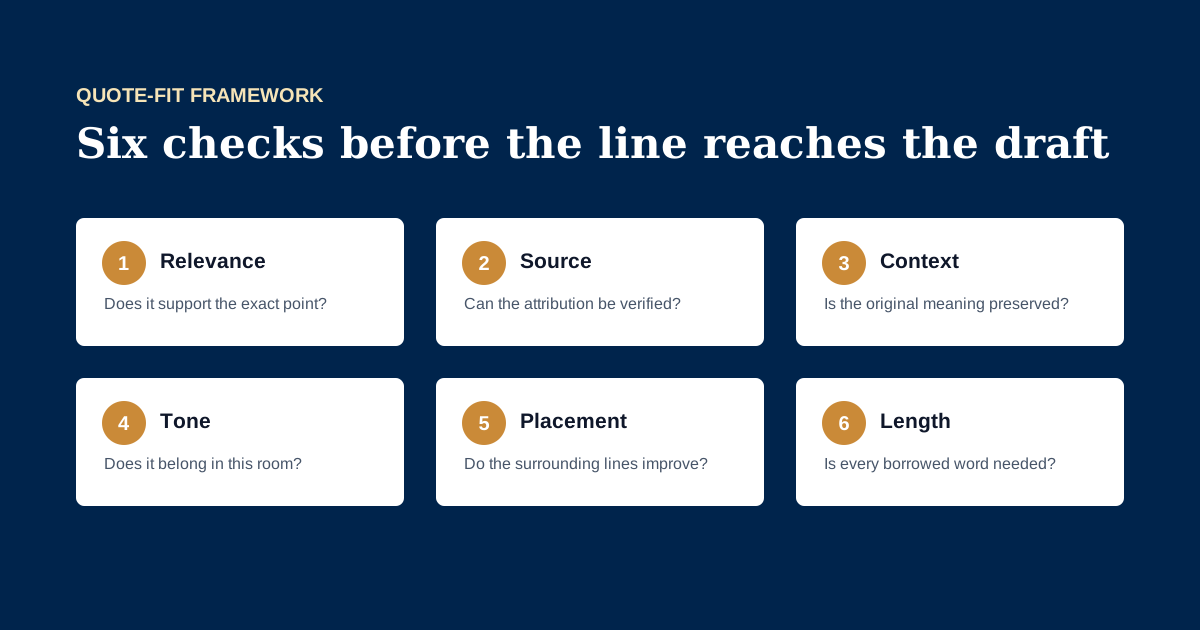
Apply the six-part quote-fit test
Once you have a candidate, evaluate it across six dimensions. They are not equally negotiable.
1. Relevance
Can you explain the connection to your exact claim in one sentence?
If the explanation depends on several leaps, the quote is probably topical decoration. A relevant quotation either supports the claim directly or creates a useful complication you intend to address.
Try completing this sentence:
This quotation belongs here because it helps the audience understand that…
If your answer merely repeats the quote, you have not yet explained its function.
2. Source confidence
Can you verify the wording, speaker, and source well enough for the stakes of the work?
A classroom essay, published article, investor presentation, and casual internal message do not carry identical citation expectations. They all benefit from accurate attribution. Do not trade accuracy for a more recognizable name.
The Library of Congress quotation research guide provides a careful process for identifying original sources and investigating misquotations. Use quotation websites and AI tools for discovery; use original or authoritative sources for verification.
3. Context
Does the original passage mean what the isolated sentence appears to mean?
Read around the line. Check whether it is ironic, fictional dialogue, a view later rejected, or a response to a very specific event. A quotation can be word-for-word accurate and still become misleading when the context disappears.
4. Tone
Does the quote belong in this room?
A grand philosophical sentence can overwhelm a practical team update. A playful line can weaken a serious memorial. A sentimental quotation can make a measured essay sound less trustworthy.
Tone is relational. Judge it against the audience, occasion, and sentences around it rather than labeling the quotation in isolation.
5. Placement
Do the surrounding sentences become stronger?
Paste the candidate into its proposed location. Read the complete passage aloud. Watch for three problems:
- The setup becomes long because you must defend why the quote is relevant.
- The following sentence merely paraphrases the quote without advancing the point.
- Your prose changes voice abruptly and struggles to recover afterward.
A well-placed quotation feels prepared for and responded to. It should not arrive as an interruption.
6. Length
Are you borrowing only the words you need?
Long quotations slow articles and speeches, and they compete with speakers on slides. Shortening can help, but preserve the original meaning and follow the relevant style rules when using ellipses or brackets.
If one phrase contains the useful insight, do not make the audience carry the full paragraph.
Treat the first two checks as gates
The interactive quote-fit checklist gives one point for each dimension, but the number needs interpretation.
A candidate that passes tone, placement, context, and length but fails relevance is polished irrelevance. A candidate that fits perfectly but has an unreliable attribution exposes the work to an avoidable accuracy problem.
Require both relevance and source confidence. Use the other four checks to choose among candidates that have cleared those gates.
Compare candidates, not impressions
When several quotations feel plausible, compare them in a small table:
| Test | Candidate A | Candidate B | Candidate C |
|---|---|---|---|
| Supports the exact claim | Strong | Partial | Strong |
| Source is verified | Yes | Unclear | Yes |
| Original context is fair | Yes | Unknown | Yes |
| Fits the tone | Too grand | Good | Good |
| Improves the placement | Partial | Good | Strong |
| Fits the format | Too long | Good | Good |
This makes tradeoffs visible. Candidate A may be the most impressive sentence and still lose because it overpowers the material. Candidate C may be less famous and more useful.
Adjust the test to the format
The six dimensions remain stable, but formats change their weight.
For a speech, prioritize spoken rhythm, audience fit, and whether the quote requires too much setup.
For an article, prioritize source links, framing, and the quality of your response after the quotation.
For a presentation, prioritize brevity, legibility, and whether the quote should be shown, spoken, or both.
For an essay, prioritize source rules, citation, and analysis that keeps your argument in charge.
For a social post, prioritize context and attribution because shortening and visual formatting can make a circulating misquotation look more authoritative than it is.
The dedicated guides on speech quotations, presentation quotations, and quotes in articles apply the framework to those settings.
Search again when the fit is weak
Rejecting a candidate is progress. The failed check tells you how to improve the next search.
- Weak relevance: include the full claim rather than the topic.
- Wrong tone: describe the emotional temperature explicitly.
- Too long: request a concise or slide-length line.
- Poor placement: change the quote’s job from opening to support or transition.
- Unclear source: search for another candidate with a traceable original work.
Qurate is useful at this stage because you can revise the search around meaning, audience, role, and tone instead of swapping one keyword for another.
Choose the line that makes your work clearer
The quote is not the destination. The audience’s understanding is.
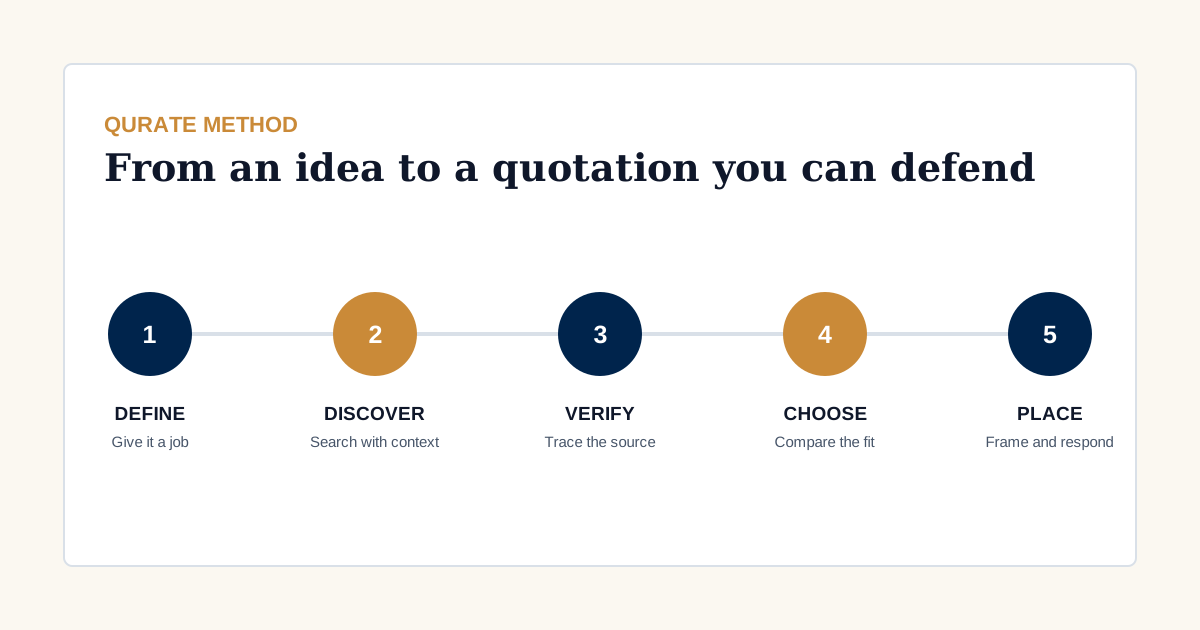
Write the claim, name the missing support, search for several candidates, verify them, and compare their fit in the real passage. The winning quotation is the one that makes your point easier to understand and your work more credible without taking control away from your own voice.
Find candidates in Qurate, then bring the shortlist through the quote-fit checklist before making the final choice.
Continue in Qurate
Search with the context you have already worked out.
Bring the idea, audience, setting, and tone from this guide into Qurate, then compare the matches in your actual draft.

Written by
App Cradle Editorial Team
The App Cradle team writes from hands-on product work in quote discovery, writing tools, and semantic language exploration.
Continue learning
Take the next useful step.
 Quote Research
The Complete Guide to Finding, Verifying, and Using Quotations
A practical end-to-end method for finding a quotation, checking its source and context, and placing it naturally in a speech or piece of writing.
Read the guide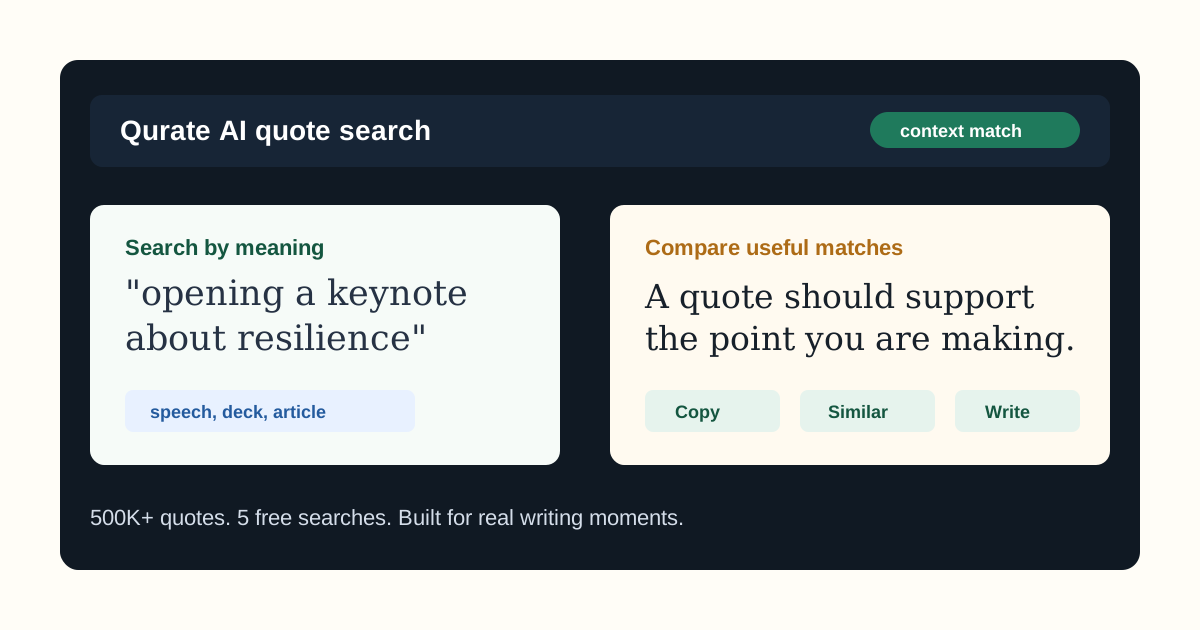 Quote Search
Semantic Quote Search: Find Quotes by Meaning, Not Just Keywords
A human guide to semantic quote search: how to find quotes by meaning, tone, and context when exact keywords are not enough.
Read the guideWritingHow to Use Quotes in Articles Without Sounding Generic
Learn how to use quotes in articles with better judgment, stronger framing, and less of that pasted-in internet quote feeling.
Read the guide