
What you will be able to do
Use this guide to make a better decision.
- Give the quote a specific role before searching.
- Account for the room, audience, and emotional temperature.
- Test the line aloud between the sentences surrounding it.
A quote can give a speech a clean opening, a memorable turn, or a quiet moment where the room catches up with you. It can also make a speech sound like it was assembled from other people’s best sentences.
The difference is fit. The right quote does not announce, “Here is a famous line.” It helps the audience understand why this moment matters.
That is why the best way to find quotes for speeches is not to start with “leadership quote” or “success quote.” Those searches return plenty of options, but most of them make you do the real work afterward. You still have to decide whether the quote belongs in this room, for this audience, at this point in the speech.
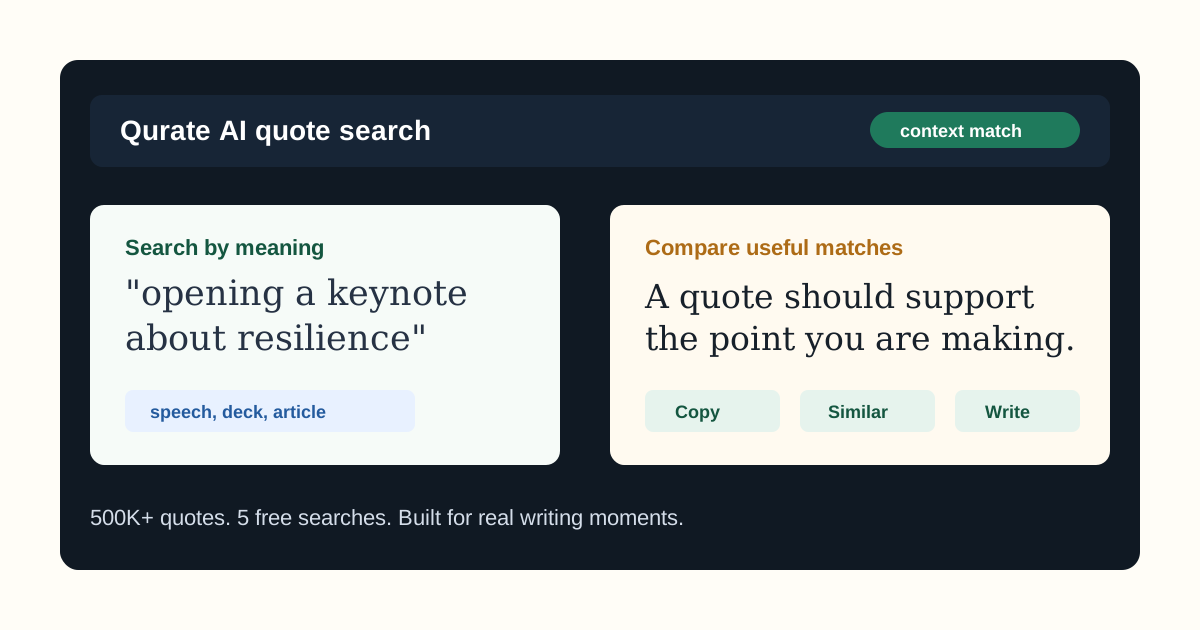
Qurate helps by letting you search with the context of the speech itself: the audience, tone, role of the quote, and message you are trying to land.
Give the quote a job before you search
Before you look for a line, decide what the quote should do.
An opening quote should get the room oriented quickly. It needs enough clarity that people can follow you before they know where the talk is going.
A transition quote should move the audience from one idea to the next. It can create contrast, reset attention, or slow the pace before a heavier section.
A proof quote should support the point without stealing the point. If the quote is louder than your argument, it may not be helping.
A closing quote should feel earned. It should give the audience a final shape for the message, not a neat bow that arrives out of nowhere.
Those roles produce very different searches. “A quote about resilience” is vague. Try:
a concise quote to open a keynote about resilience after a difficult year
Now the quote has a place to stand.
Add the room, not just the topic
Audience fit matters more than fame. A quote that works beautifully in a graduation speech might feel sentimental in a quarterly business review. A sharp line that wakes up a conference audience might feel too severe in a toast.
When you search, include the room:
- A leadership team making a strategy decision.
- Students preparing for a debate.
- A team rebuilding trust after a difficult quarter.
- Donors gathered around a nonprofit mission.
- Creators in a practical workshop.
Then add the tone. Do you need calm, hopeful, direct, warm, witty, serious, reflective, or plainspoken?
Useful prompts sound like real speaking situations:
- “A calm quote for opening a team meeting about rebuilding trust.”
- “A sharp quote for a keynote about focus during rapid growth.”
- “A hopeful quote to close a graduation speech about uncertainty.”
This is the same principle behind semantic quote search: search by meaning and purpose, not just exact words.
Watch for quotes that overpower the speech
Some quotes are too famous for the job. People hear the line, remember the poster, and stop listening to you. Other quotes are so dramatic that they tilt the emotional temperature of the room before you have earned it.
Three warning signs are worth catching early.
First, the quote needs too much setup. If you have to spend a full minute explaining why it belongs, the line may slow you down.
Second, the quote is familiar in a way that drains it. Familiar does not always mean bad, but it can make a serious point feel generic.
Third, the quote changes the tone. A practical talk can be weakened by a grand line. A warm speech can be chilled by something too severe.
Once you have a candidate, read it between the two sentences where it would live in the speech. If the surrounding sentences become stronger, keep it. If they start bending around the quote, keep searching.
Think about the slide, too
Many speeches are paired with decks. A quote that sounds beautiful out loud may be too long on screen. If the audience is reading while you are speaking, the slide has to be simple enough to let attention return to you.
For slide-heavy talks, use the guide on quotes for presentations to decide whether the quote should be spoken, shown, or both.
If the speech will turn into posts, clips, or launch content, the guide to quotes for social media campaigns can help you adapt the idea without flattening it into generic content.
A simple speech quote workflow
Use this before opening a quote search:
- Write the point of the section in one sentence.
- Name the audience.
- Choose the quote’s role: opening, transition, proof, or closing.
- Choose the tone.
- Search with the full context.
- Compare a few options before choosing.
For example:
a short, hopeful quote to close a team all-hands about staying focused after a difficult product launch
That prompt gives Qurate a real writing problem. The result is easier to judge because you already know what the quote needs to accomplish.
Try Qurate before your next talk
If you are preparing a keynote, toast, team update, lecture, pitch, sermon, or panel intro, test Qurate with one real moment from the speech.
Try Qurate with 5 free searches. If a result helps the talk sound more like you, not less, the monthly and annual plans remove the search limits for regular work.
Continue in Qurate
Search with the context you have already worked out.
Bring the idea, audience, setting, and tone from this guide into Qurate, then compare the matches in your actual draft.

Written by
App Cradle Editorial Team
The App Cradle team writes from hands-on product work in quote discovery, writing tools, and semantic language exploration.
Continue learning
Take the next useful step.
 Quote Search
Semantic Quote Search: Find Quotes by Meaning, Not Just Keywords
A human guide to semantic quote search: how to find quotes by meaning, tone, and context when exact keywords are not enough.
Read the guidePresentationsHow to Find Quotes for Presentations and Slide Decks
A practical guide to finding quotes for presentations that are readable, relevant, and useful on real slides.
Read the guideMarketingHow to Match Quotes to Social Media and Marketing Campaigns
A practical guide for marketers and creators who want campaign quotes that fit the audience, channel, and brand voice.
Read the guide