
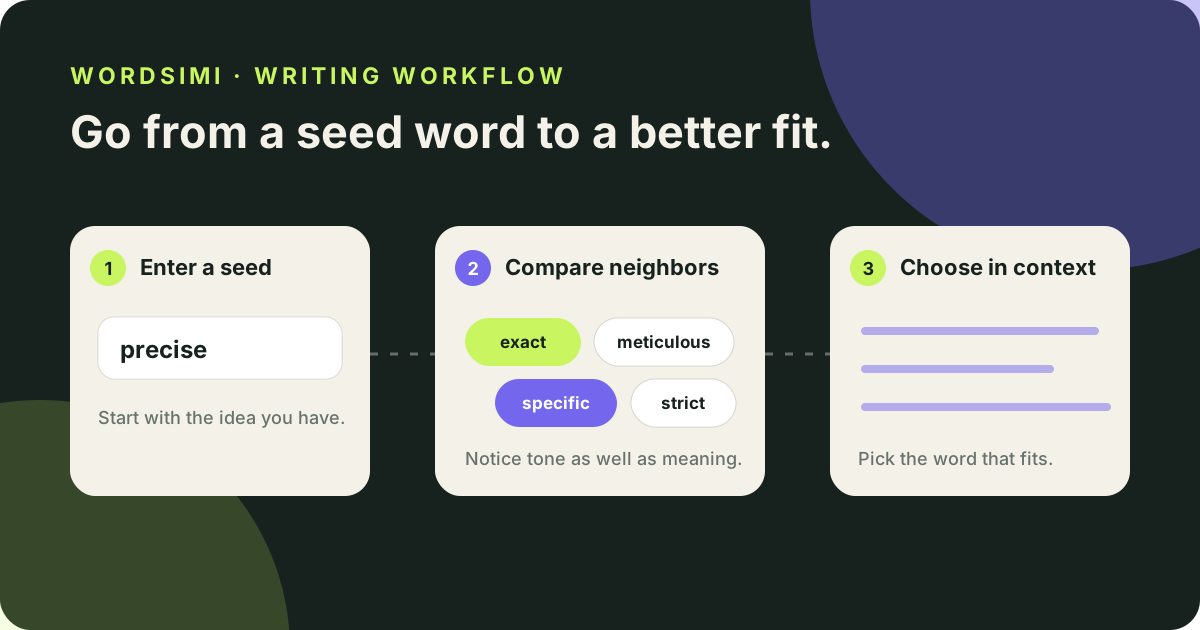
A blank page is not always the problem. Sometimes the page already has a word, but it is carrying too much weight.
You may have written innovative three times in a product page. A project name may sound accurate but forgettable. A paragraph may need a word that is less cheerful than hopeful but warmer than optimistic. A conventional synonym list can help, yet the best option may not be a synonym at all.
A semantic word neighborhood gives you more directions. It shows words that the model learned near a seed in language space. That can include substitutes, adjacent ideas, topic companions, and tonal alternatives. WordSimi makes those neighborhoods quick to inspect across a 400,000-word vocabulary.
The trick is to use the results as prompts for judgment, not as copy to accept automatically.
Start with the job, not the word
Before searching, write down what the new word must do.
For a sentence, ask whether it needs precision, rhythm, emotional temperature, or a less repeated term. For a product name, ask what the name should signal: speed, trust, craft, play, intelligence, calm, or something else. For vocabulary study, decide whether you want synonyms, topic words, or contrasts.
This prevents a common failure mode: choosing a fascinating neighbor that does not solve the real problem.
Suppose the sentence is:
The tool gives teams a clear view of their campaign.
If the problem is repetition, a nearby word like transparent might help. If the problem is vagueness, the sentence may need auditable, complete, or recipient-level instead. Those are different jobs. Semantic exploration widens the candidate set; the sentence still defines the selection criteria.
Use a three-pass workflow
The most reliable workflow separates expansion from evaluation.
Pass 1: expand
Search the seed word and collect candidates without editing yet. Note direct substitutes and surprising adjacent concepts. If one result suggests a promising direction, search that word too.
For a naming exercise around harbor, one branch might emphasize safety: shelter, haven, refuge. Another might emphasize arrival and departure: port, dock, anchorage. A third might emphasize navigation: beacon, channel, compass. The branches are more valuable than one long undifferentiated list.
Pass 2: classify
Group candidates by the relationship you see:
- Same meaning, different register.
- Same topic, different object.
- More concrete or more abstract.
- Warmer, colder, stronger, or softer tone.
- Useful metaphor rather than literal replacement.
Classification stops semantic neighbors from masquerading as synonyms. Compass may be a strong name inspired by guidance, but it cannot replace guidance in every sentence.
Pass 3: test
Put short-listed words into their real context. Read the full sentence aloud. Place the name beside the product description. Check how it looks in lowercase, a URL, and a support email. Search for unintended meanings and existing brands.
The winning candidate is the one that survives context, not the one with the shortest vector distance.
Improve a sentence without flattening its voice
Writers often reach for the most familiar synonym and accidentally change tone. Small, compact, tiny, modest, and slight overlap, but they do different emotional work.
Use the neighborhood to form a tone ladder. Put restrained candidates at one end and vivid candidates at the other. Then choose the point that matches the piece.
You can also search an adjective and a noun separately. If powerful insight feels generic, explore powerful for intensity and insight for the underlying concept. The better revision may be sharp observation, decisive signal, or a rewritten sentence that avoids both original words.
This is why semantic word similarity is broader than thesaurus lookup. Nearby words can expose a different framing, not just a replacement token.
Generate product and feature naming territories
Do not ask one seed word to produce a final name. Use it to create territories.
For a product about collaboration, you might begin with:
- Together for belonging.
- Relay for handoffs.
- Studio for shared craft.
- Converge for bringing work together.
Search each seed and build a small cluster. Then label the territory in plain language. “Fast handoff” is easier for a team to evaluate than a page of thirty disconnected names.
After the semantic phase, apply practical filters:
- Is it easy to pronounce and spell?
- Does the domain or app-store context create confusion?
- Is it overly descriptive or legally risky?
- Does it travel well across the markets you care about?
- Can the brand grow beyond the first feature?
WordSimi does not perform trademark clearance, domain research, or multilingual review. Those are essential later steps. Its job is to help you escape the first obvious naming circle.
Build vocabulary through contrast and connection
Word neighborhoods can also support deliberate learning. Search a new word, pick several neighbors, and write one sentence explaining how each differs from the seed. That is more active than memorizing a list.
For frugal, you might compare thrifty, economical, sparing, and stingy. The cluster makes the shared idea visible; your notes establish connotation and usage.
Always verify unfamiliar results in a dictionary and, when possible, inspect examples from a corpus. Vector proximity is useful evidence that words occur in related patterns. It is not a definition.
Keep the tool in the idea phase
Semantic search is strongest early, when the candidate space is too narrow. It is less useful as a final authority. A practical rhythm is:
- Define the writing or naming job.
- Explore several seed neighborhoods.
- Organize candidates into meaningful directions.
- Test them in context.
- Validate usage, availability, and risk elsewhere.
Open WordSimi with a word from your current draft or naming brief. Approximation is fine at this stage: you are looking for useful directions, not claiming one mathematically ordained answer.
Continue in WordSimi
Test the idea with a word from your own work.
Search one seed word, inspect the nearest semantic neighbors, and validate the promising directions in a dictionary or your draft.

Written by
App Cradle Editorial Team
The App Cradle team writes from hands-on product work in quote discovery, writing tools, and semantic language exploration.
Continue learning
Take the next useful step.
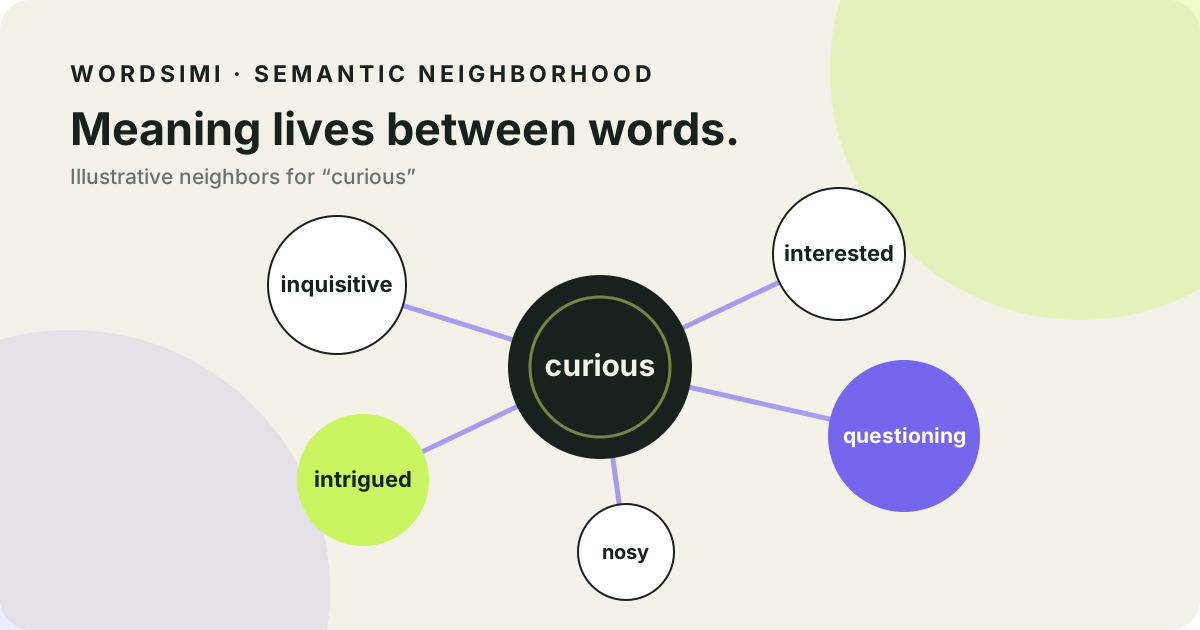 Semantic Search
Semantic Word Similarity: Find Words by Meaning, Not Spelling
Learn what semantic word similarity measures, how a word neighborhood differs from a thesaurus, and how to explore one with WordSimi.
Read the guide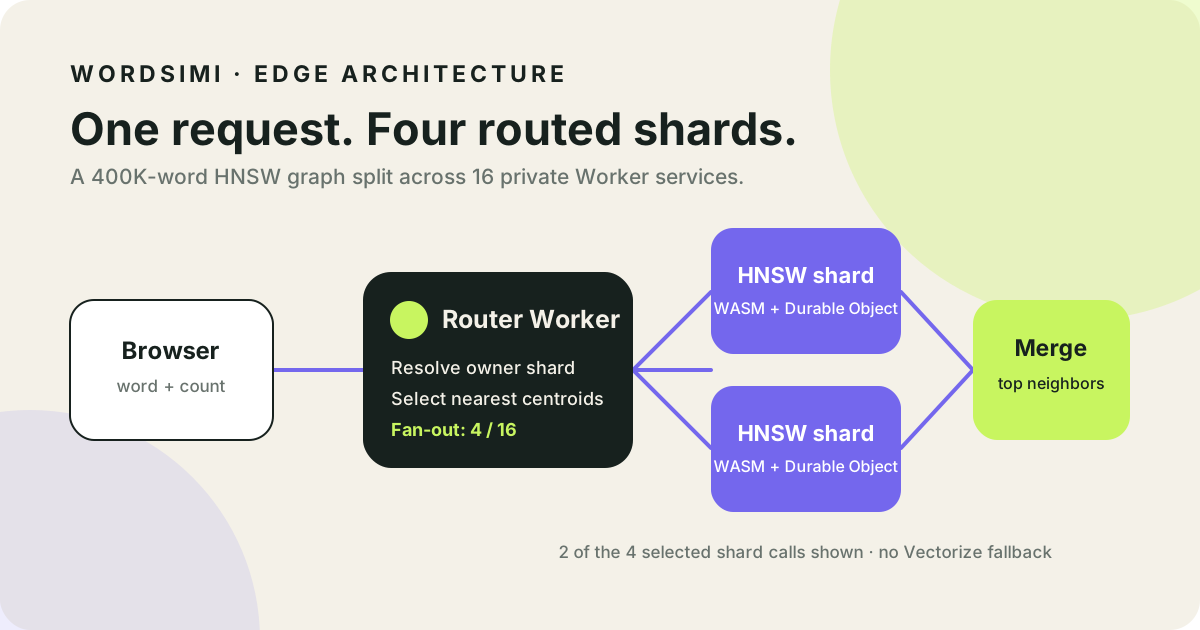 Edge Architecture
How WordSimi Runs HNSW-WASM on Cloudflare Workers
An engineering tour of WordSimi's sharded HNSW-WASM search: 16 private shards, four-shard routing, Durable Objects, caching, and no Vectorize fallback.
Read the guide